Rust LA continues to grow: Exploring real-world adoption and the reality of migration
 By Jenna O'BrienApril 28, 20261 min read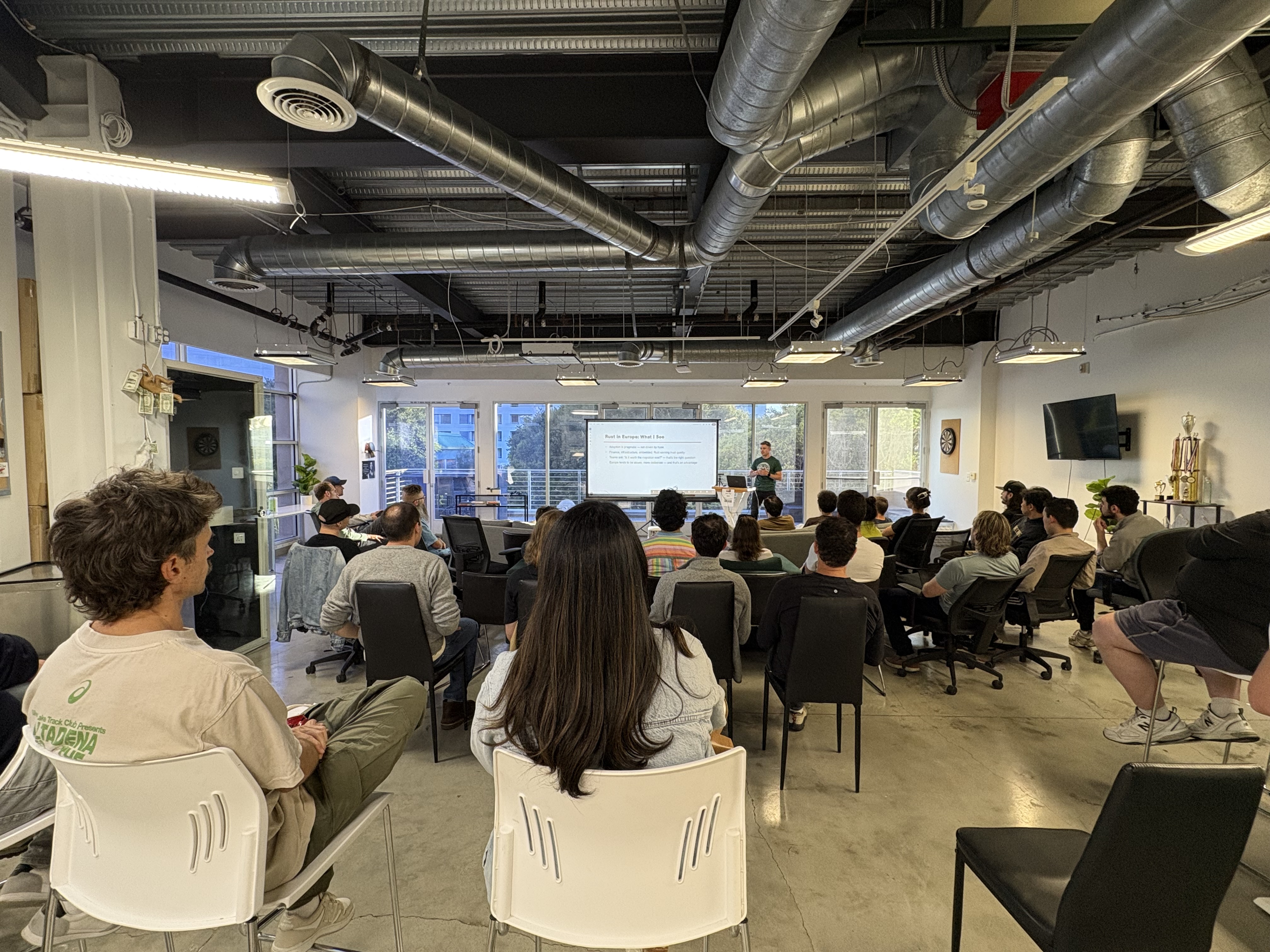

Share
The Rust LA community returned for another strong evening, bringing together engineers, leaders, and anyone curious about where Rust is heading.
What stands out at these events isn’t just the technical side, it’s the honesty in the room. You’ve got people just starting out with Rust, alongside those who’ve been working with it for years, all sharing what’s actually happening in their day-to-day work.
This session focused on two key themes: what it really means to migrate to Rust, and what adoption looks like inside large, complex organisations.

Rust migration: what actually happens in practice
Kicking things off, Wojciech Kargul spoke about what migration actually looks like in practice, and it’s rarely as straightforward as people expect.
A lot of older systems “work”, but more because nothing has forced them not to. Once you start moving things over, you quickly realise how much isn’t fully understood, assumptions that were never documented, bits of behaviour no one really questions, and areas where ownership isn’t clear.
That’s where things get interesting.
As Wojciech put it: “Migration to Rust isn’t a modernisation project, it’s an honesty project.”
It’s less about rewriting code, and more about working out what your system is actually doing in the first place.
What Rust adoption looks like in real-world teams
The second talk came from Yuri Astrakhan and Sean Bentley at Rivian and Volkswagen Group Technology, and it grounded a lot of that in reality.
They talked through where Rust is actually being used today, things like internal tooling, cloud services, and embedded systems, but the more interesting part was how it gets introduced in the first place. It’s rarely a clean switch.
Most teams are working around existing systems, tight deadlines, and ways of doing things that have been in place for years. Getting Rust in usually takes time, a bit of pushing, a bit of proving it works, and gradually building trust.
At the end of the day, it’s less about the language itself and more about how people buy into it.
Why Rust is gaining ground, and what’s next
Even with some of the challenges around adoption, it’s clear Rust is starting to find its place.
More teams are picking it up where reliability really matters, and more engineers are taking the time to properly get comfortable with it. There’s also a bit of an interesting balance with AI right now, things are speeding up, but you still need systems you can trust. That’s where Rust fits in. A lot of that momentum comes back to community.
Events like Rust LA give people a chance to share what they’re actually seeing day to day, what’s working, what isn’t, and how they’re figuring things out. That’s what helps everything move forward.
And you can see it, each event feels a bit bigger, a bit more confident.
If you missed this one, there’s more to come.
Enjoy more articles



Looking for your next role in technology?
We’ve been helping clients achieve the results they need for over 20 years. In that time, we’ve refined ou. We’ve been helping clients achieve the results they need for over 20 years. In that time, we’ve.